How to Photograph the Milky Way: Settings, Focus and the Exposure Rules
How to photograph the Milky Way: tripod, manual mode, the widest aperture, ISO 3200 to 6400 and a shutter from the 500 or NPF rule. Focus, phones, and when the core is up.
To photograph the Milky Way, put the camera on a tripod in manual mode, open the lens to its widest aperture (f/2.8 or wider), set ISO 3200 to 6400, focus by hand on a bright star, and keep the shutter short enough that the stars stay points: about 15 to 25 seconds on a wide lens. Shoot RAW, on a moonless night, when the core is up.
Join a Milky Way photography hike →
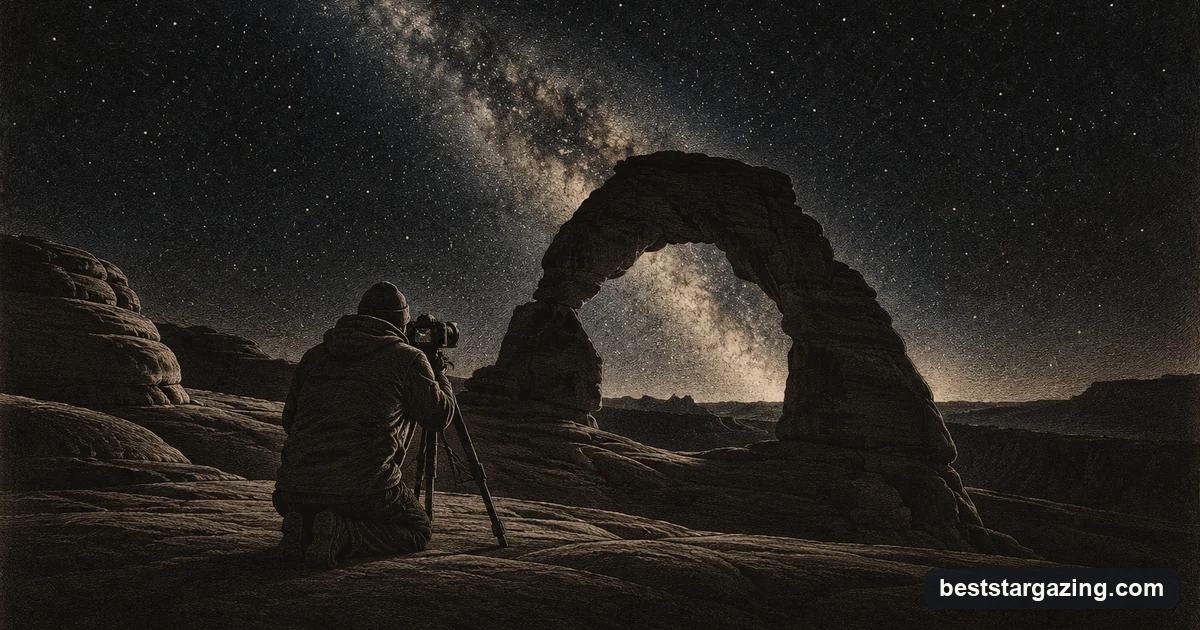
The settings
| Setting | Start here | Why |
|---|---|---|
| Mode | Manual | The camera’s meter cannot judge a dark sky |
| Lens | 14 to 24 mm on full frame | Wide lenses allow longer shutters and fit the band |
| Aperture | The widest your lens has, f/2.8 or wider | Every stop of light counts |
| ISO | 3200 to 6400 | Lower is cleaner; raise it if the sky is too dark |
| Shutter | From the 500 or NPF rule | Longer, and the stars trail |
| Focus | Manual, on a bright star at full magnification | Autofocus hunts in the dark |
| White balance | About 3,800 to 4,200 K, or fix it in RAW | Keeps the sky from going orange |
| File | RAW | Room to pull detail out of the shadows |
Use the self-timer or a remote so pressing the button does not shake the tripod.
The 500 rule and the NPF rule
The 500 rule: divide 500 by the focal length to get the longest shutter in seconds before the stars visibly trail. On a crop-sensor camera, multiply the focal length by the crop factor first. A 24 mm lens on full frame gives about 21 seconds.
The NPF rule, devised by Frédéric Michaud of the Société Astronomique du Havre, is stricter and allows for your sensor’s pixel size: shutter in seconds ≈ (35 × aperture + 30 × pixel pitch in microns) ÷ focal length. For a 24 mm f/2.8 lens on a camera with 5.97 µm pixels, it gives about 12 seconds, against the 500 rule’s 21. On today’s high-resolution sensors the 500 rule leaves visible trails; start from the NPF figure.
Focus, the hardest part
Turn autofocus off, switch the screen to live view, magnify on the brightest star or planet, and turn the focus ring until the star is the smallest point you can get. Then tape the ring. The infinity mark on most lenses is not quite infinity.
With a phone
Phones with a night or astrophotography mode can catch the Milky Way, if the phone sits on a tripod or a rock for the whole exposure. Turn the flash off, let the exposure run, and edit the result. You will not get the detail of a camera, but you will get the band.
When and where
The core shows best from May to July at nine of the ten places on this site, and only after full darkness. Each destination page shows its own core season in the month chart, the next new moons in the night calendar, and computed star charts of where the core sits on the best nights. For the moon and the month, see the best time to go stargazing.
Tours that help with the camera
- Moab Dark Sky Tours, at The Windows in Arches National Park: a guide who helps with the settings, tripods lent if needed and a camera or lens to rent, from US$175 (as of October 2026). See Utah stargazing tours.
- Atacama Dark Sky, outside San Pedro de Atacama: photos of you with the Milky Way, and deep-sky photos sent the next day. See Atacama Desert stargazing.
- Hawaii Island Holidays, on Mauna Kea: free night photos by email. See Mauna Kea stargazing.
- Stargazing Joshua Tree: deep-space photography to take home. See Joshua Tree stargazing.
Pack for the cold as well as the camera: what to wear stargazing.
Book Your Experience
Check Availability & Prices
Select your preferred date and time. Cancel up to 24 hours in advance for a full refund.
Shoot the Milky Way in Arches
A night hike to The Windows in Arches National Park with a guide who helps with the camera settings, tripods lent and a camera or lens to rent.
Check the Arches Night Hike