The Darkest Stargazing Destinations, Ranked by Published Sky Readings
Ten stargazing destinations ranked by their published sky-brightness readings, with where and when each was measured, the Bortle estimate, designation and best months.
Of the ten stargazing destinations on this site, Lake Tekapo has the darkest published reading for the place the tours use, and Mauna Kea’s published readings span a range that reaches darker still. Joshua Tree’s reading comes from the park’s brighter north-west edge, near where its telescope tour meets. The other seven have no published measurement for the place the tours observe from, and they sit unranked at the bottom: no number is better than an invented one.
Compare the Lake Tekapo tours →
The ranking
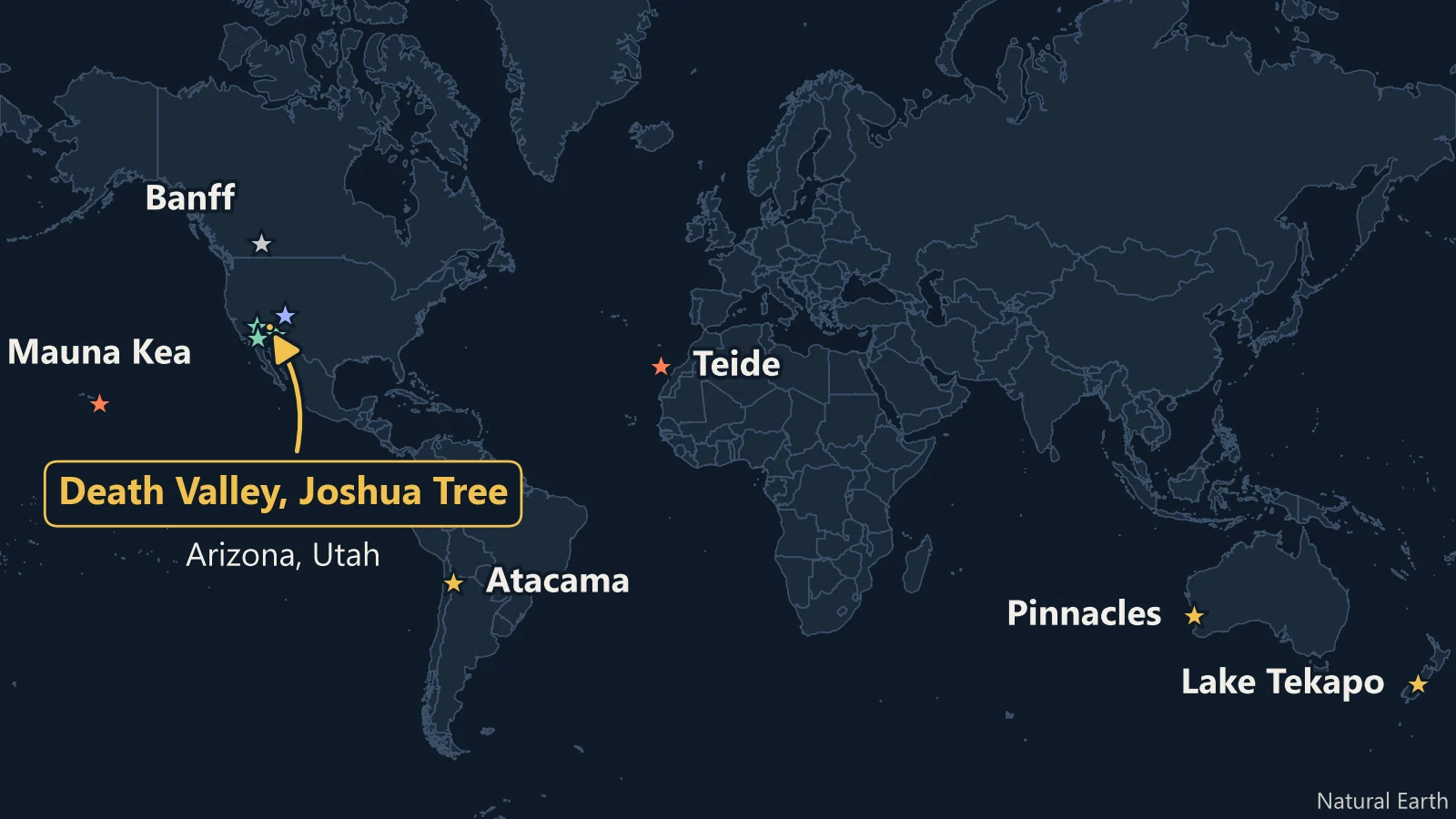
| # | Destination | Sky brightness (where, when) | Bortle class (estimated) | Designation | Best months | Night cloud, year | Elevation |
|---|---|---|---|---|---|---|---|
| 1 | Lake Tekapo | 21.67 average, darkest 21.8 mag/arcsec², Mt John main car park, June 2011 to January 2012 | ≈ 3-4, estimated; the reserve's application: 2 | International Dark Sky Reserve, 2012 | May, Jun, Jul | 60% | 1,029 m |
| 2 | Joshua Tree | 21.11 mag/arcsec², Black Rock Campground, on the park's north-west edge about 10 km from the Yucca Valley meeting point (NPS camera, zenith; all-sky mean 20.23, Keys View 20.35, the park's brightest edge), 21 February 2006 | ≈ 4, estimated; the National Park Service: 5 | International Dark Sky Park, 2017 (nearby) | May, Jun, Jul | 28% | Not published |
| – | Big Island (Mauna Kea) | 21.29 to 21.91 mag/arcsec², the 2,800 m level of Mauna Kea, September 1985 to August 1996 | No single class: the range spans more than one | None | May, Jun, Jul | 55% | 2,800 m |
| – | Arizona (Sedona) | No published measurement | Not estimated | International Dark Sky Community, 2014 (nearby) | May, Jun, Jul | 35% | Not published |
| – | Atacama Desert | No published measurement | Not estimated | None | May, Jun, Jul | 36% | 2,436 m |
| – | Banff (Lake Minnewanka) | No published measurement | Not estimated | None | No month with the core up | 71% | Not published |
| – | Death Valley | No published measurement | Not estimated | International Dark Sky Park, 2013 (nearby) | May, Jun, Jul | 39% | Not published |
| – | Pinnacles Desert | No published measurement | Not estimated | None | May, Jun, Jul | 41% | Not published |
| – | Tenerife (Teide) | No published measurement | Not estimated | Starlight Tourist Destination, 2013 | May, Jun, Jul | 59% | above 2,000 m |
| – | Utah (Arches) | No published measurement | Not estimated | International Dark Sky Park, 2019 | May, Jun, Jul | 47% | Not published |
Sky brightness from each place's published measurement (sources on the destination pages); best months and Milky Way core hours computed with JPL DE421 via Skyfield; night cloud from NASA POWER, 2001 to 2025. Checked October 2026. A higher mag/arcsec² number is a darker sky.
How each Bortle estimate was made
- Lake Tekapo: ≈ Bortle 3-4: estimated from the darkest reading, 21.8 mag/arcsec² (class 3), and the survey average, 21.67 (class 4), measured by Aoraki Mackenzie starlight reserve application to the IDA, SQM survey (Table 7-1) at Mt John main car park, June 2011 to January 2012. The reserve's application puts it at Bortle 2, its own estimate (from its 21.67 and 21.51 mag/arcsec² averages at the primary core, the two Mt John car parks, p. 39). Bortle is a visual scale; treat ±1 class as the uncertainty.
- Joshua Tree: ≈ Bortle 4: estimated from 21.11 mag/arcsec² measured by the National Park Service night-sky team, in Joshua Tree National Park's International Dark Sky Park application (June 2016, pp. 22 and 75) at Black Rock Campground, on the park's north-west edge about 10 km from the Yucca Valley meeting point (NPS camera, zenith; all-sky mean 20.23, Keys View 20.35, the park's brightest edge), 21 February 2006. The National Park Service puts it at Bortle 5, its own estimate (in its Black Rock Campground record, p. 22). Bortle is a visual scale; treat ±1 class as the uncertainty. The tours do not disclose their own observing site, so this is a published reading near where they meet, not a reading at the tour site.
How to read it
Sky brightness is measured in magnitudes per square arcsecond with a sky-quality meter, pointed straight up. A higher number is a darker sky. Readings differ within a single park, so every figure names the spot and the date it was taken.
The Bortle class is a visual scale from 1, the darkest, to 9, an inner-city sky. It was never designed to be read off a meter, so every class in the table is an estimate from the measured reading, with the conversion stated for each place. Where the measuring body gives its own class, the table shows it beside the estimate: the Lake Tekapo application puts its core two classes darker than the conventional table does. The National Park Service notes that sky-quality meters become unreliable darker than about 21.5 mag/arcsec² (NPS Night Skies metrics, checked October 2026), so a meter cannot separate the two darkest classes on the scale.
A designation from DarkSky International or the Royal Astronomical Society of Canada protects a place’s lighting; it is not a measurement. Read what a dark sky reserve is.
Unmeasured is not the same as bright. The Atacama, Teide, the Pinnacles and the others at the bottom have no published reading for the places the tours actually observe from, so they are not ranked. Each destination page says so on its sky card.
Which to pick
The darkest reading is one factor of three: the cloud and the moon decide the night more often. Use the month picker to see where the Milky Way core is up and the nights are clearest in the month you travel.
Ready to Book a Night Under the Stars?
Pick your destination: Mount Teide, Lake Tekapo, the Atacama Desert, Mauna Kea, Death Valley and more.
Compare All Ten Places