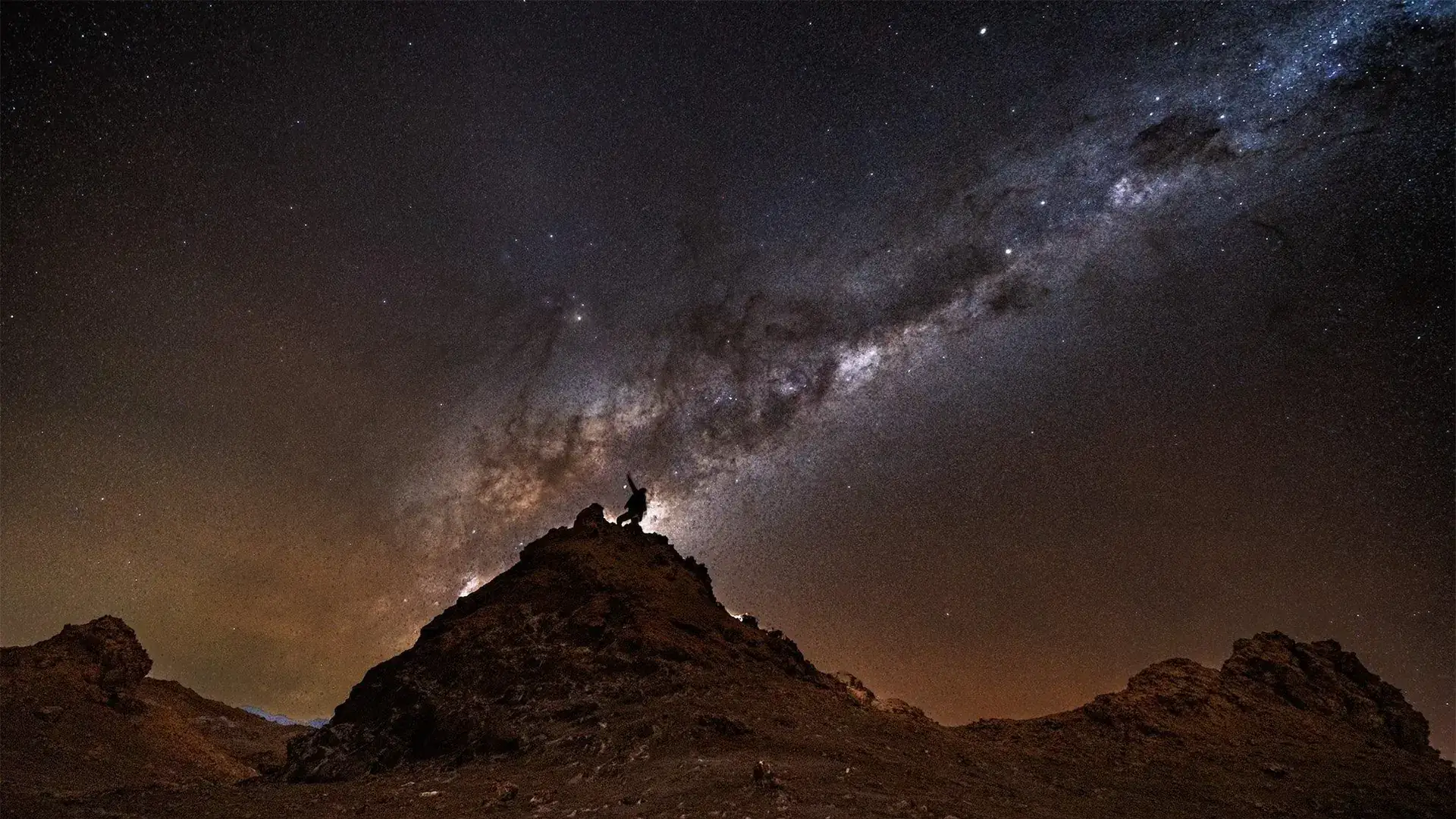
Ten dark-sky places · Prices checked October 2026
The Best Places to Stargaze, and the Tours Worth Booking There
Ten dark-sky places with a stargazing tour worth booking, from Mount Teide to Lake Tekapo, compared on published sky readings, the Milky Way season, cloud and price.
Ten Skies, Compared
Pick the Sky That Fits Your Trip
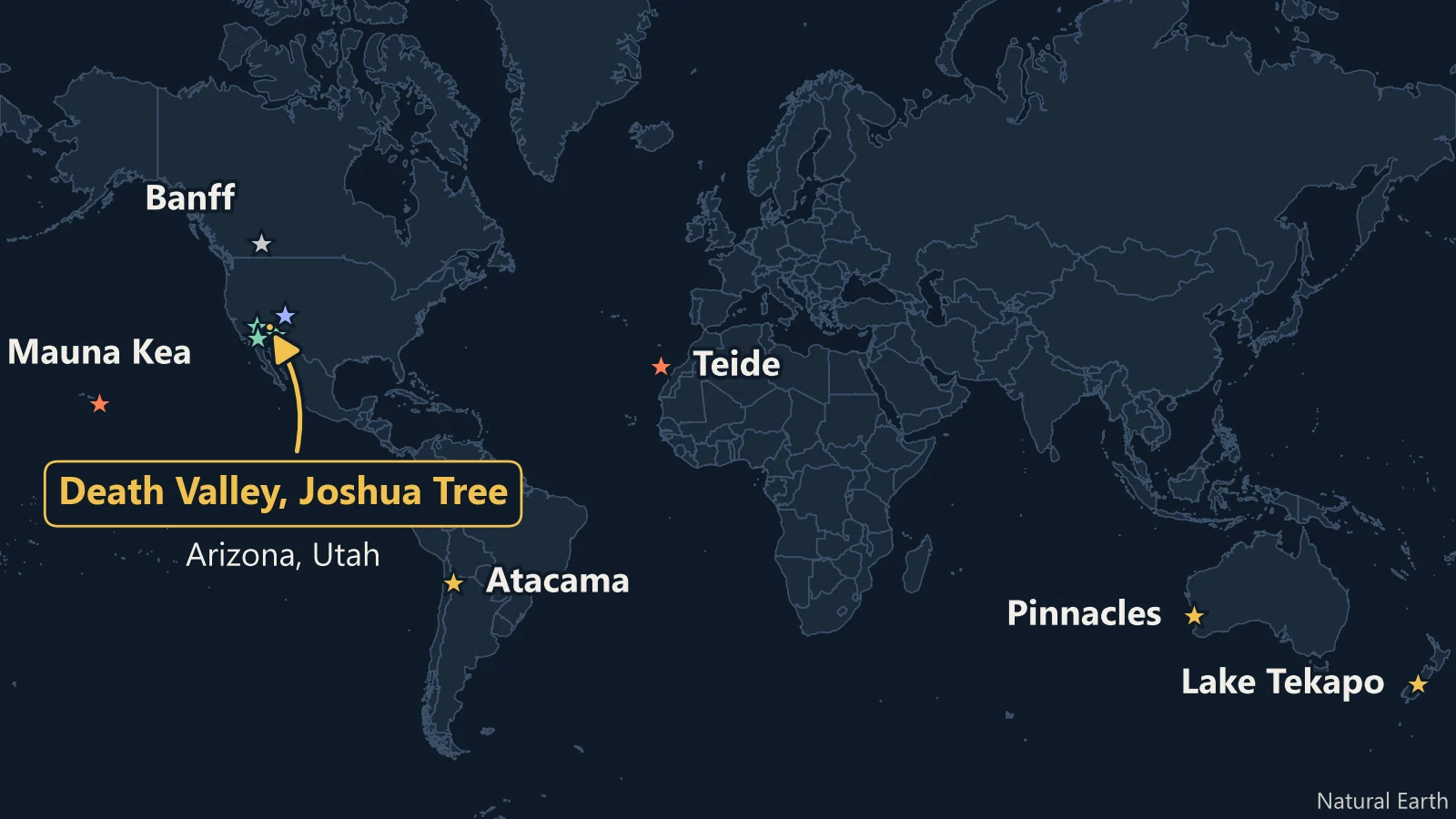
One page for each place where a stargazing tour is worth booking, with the tours compared and the free way to see the same sky named where there is one.
Mount Teide Stargazing, Tenerife
Sunset above the clouds, then telescopes in Teide National Park, with or without dinner and the cable car. The widest choice of stargazing tours of the ten.
Compare the Teide tours →Lake Tekapo Stargazing
The summit of Mt John, the crater tour and the hot pools, inside the Aoraki Mackenzie International Dark Sky Reserve.
Compare the Tekapo tours →Atacama Desert Stargazing
Telescope nights outside San Pedro de Atacama, with astrophotos and Andean star stories, plus Elqui Valley and Rapa Nui.
Compare the Atacama tours →Mauna Kea Stargazing, Big Island
Sunset at the summit, then telescopes lower down the mountain, with parkas, dinner and the drive up included.
Compare the Mauna Kea tours →Death Valley Stargazing
Day trips from Las Vegas that stay for the night sky, and telescope nights in Nevada, next to a Gold Tier dark sky park.
Compare the Death Valley tours →Joshua Tree Stargazing
An astronomer, deep-sky telescopes and loungers near the park, or a guided starlight hike inside it.
Compare the Joshua Tree tours →Utah Stargazing Tours
Night hikes in Arches and telescope sessions near Moab, in a state with more than 20 dark sky places.
Compare the Utah tours →Arizona Stargazing Tours
Private nights on the forest land around Sedona, Lowell Observatory in Flagstaff and the night programs of Kitt Peak.
Compare the Arizona tours →Banff and Jasper Stargazing
Heated chairs by Lake Minnewanka, a sunset walk from Banff and the Jasper Planetarium, with a chance of the northern lights.
Compare the Rockies tours →Pinnacles Desert Stargazing
Sunset among the limestone pillars of Nambung National Park, then the southern sky, on a day trip from Perth.
Compare the Pinnacles tours →Pick your month
Where to Stargaze, Month by Month
The ten places ranked for each month by the hours of Milky Way core in full darkness and the share of clear nights. Core hours computed with JPL DE421 via Skyfield; night cloud from NASA POWER, 2001 to 2025; checked October 2026.
| # | Destination | Milky Way core, hours a night | Night cloud | Published sky reading |
|---|---|---|---|---|
| 1 | Atacama Desert | 0.1 | 47% | None published |
| 2 | Pinnacles Desert | Not up | 35% | None published |
| 3 | Joshua Tree | Not up | 39% | 21.11 mag/arcsec² |
| 4 | Arizona (Sedona) | Not up | 42% | None published |
| 5 | Death Valley | Not up | 46% | None published |
| 6 | Utah (Arches) | Not up | 52% | None published |
| 7 | Big Island (Mauna Kea) | Not up | 52% | 21.29 to 21.91 mag/arcsec² |
| 8 | Tenerife (Teide) | Not up | 61% | None published |
| 9 | Lake Tekapo | Not up | 63% | 21.67 average, darkest 21.8 mag/arcsec² |
| 10 | Banff (Lake Minnewanka) | Not up | 74% | None published |
| # | Destination | Milky Way core, hours a night | Night cloud | Published sky reading |
|---|---|---|---|---|
| 1 | Pinnacles Desert | 1.6 | 39% | None published |
| 2 | Atacama Desert | 1.7 | 44% | None published |
| 3 | Lake Tekapo | 1.3 | 59% | 21.67 average, darkest 21.8 mag/arcsec² |
| 4 | Big Island (Mauna Kea) | 0.6 | 57% | 21.29 to 21.91 mag/arcsec² |
| 5 | Tenerife (Teide) | 0.2 | 62% | None published |
| 6 | Joshua Tree | Not up | 38% | 21.11 mag/arcsec² |
| 7 | Arizona (Sedona) | Not up | 42% | None published |
| 8 | Death Valley | Not up | 47% | None published |
| 9 | Utah (Arches) | Not up | 53% | None published |
| 10 | Banff (Lake Minnewanka) | Not up | 69% | None published |
| # | Destination | Milky Way core, hours a night | Night cloud | Published sky reading |
|---|---|---|---|---|
| 1 | Atacama Desert | 3.9 | 31% | None published |
| 2 | Pinnacles Desert | 4.0 | 39% | None published |
| 3 | Lake Tekapo | 4.1 | 58% | 21.67 average, darkest 21.8 mag/arcsec² |
| 4 | Big Island (Mauna Kea) | 2.2 | 62% | 21.29 to 21.91 mag/arcsec² |
| 5 | Tenerife (Teide) | 1.4 | 64% | None published |
| 6 | Joshua Tree | 0.7 | 35% | 21.11 mag/arcsec² |
| 7 | Arizona (Sedona) | 0.6 | 36% | None published |
| 8 | Death Valley | 0.3 | 46% | None published |
| 9 | Utah (Arches) | 0.1 | 52% | None published |
| 10 | Banff (Lake Minnewanka) | Not up | 75% | None published |
| # | Destination | Milky Way core, hours a night | Night cloud | Published sky reading |
|---|---|---|---|---|
| 1 | Atacama Desert | 6.1 | 30% | None published |
| 2 | Pinnacles Desert | 6.3 | 44% | None published |
| 3 | Lake Tekapo | 6.7 | 59% | 21.67 average, darkest 21.8 mag/arcsec² |
| 4 | Big Island (Mauna Kea) | 3.8 | 61% | 21.29 to 21.91 mag/arcsec² |
| 5 | Joshua Tree | 2.0 | 30% | 21.11 mag/arcsec² |
| 6 | Arizona (Sedona) | 1.8 | 31% | None published |
| 7 | Tenerife (Teide) | 2.9 | 62% | None published |
| 8 | Death Valley | 1.5 | 42% | None published |
| 9 | Utah (Arches) | 0.9 | 52% | None published |
| 10 | Banff (Lake Minnewanka) | Not up | 72% | None published |
| # | Destination | Milky Way core, hours a night | Night cloud | Published sky reading |
|---|---|---|---|---|
| 1 | Atacama Desert | 8.3 | 36% | None published |
| 2 | Pinnacles Desert | 8.6 | 43% | None published |
| 3 | Lake Tekapo | 9.2 | 59% | 21.67 average, darkest 21.8 mag/arcsec² |
| 4 | Joshua Tree | 3.3 | 23% | 21.11 mag/arcsec² |
| 5 | Big Island (Mauna Kea) | 5.4 | 55% | 21.29 to 21.91 mag/arcsec² |
| 6 | Arizona (Sedona) | 3.2 | 24% | None published |
| 7 | Death Valley | 2.8 | 37% | None published |
| 8 | Tenerife (Teide) | 4.3 | 63% | None published |
| 9 | Utah (Arches) | 2.1 | 48% | None published |
| 10 | Banff (Lake Minnewanka) | Not up | 70% | None published |
| # | Destination | Milky Way core, hours a night | Night cloud | Published sky reading |
|---|---|---|---|---|
| 1 | Atacama Desert | 10.0 | 38% | None published |
| 2 | Pinnacles Desert | 10.4 | 51% | None published |
| 3 | Lake Tekapo | 11.2 | 55% | 21.67 average, darkest 21.8 mag/arcsec² |
| 4 | Joshua Tree | 4.2 | 16% | 21.11 mag/arcsec² |
| 5 | Big Island (Mauna Kea) | 6.8 | 51% | 21.29 to 21.91 mag/arcsec² |
| 6 | Arizona (Sedona) | 4.0 | 19% | None published |
| 7 | Death Valley | 3.5 | 28% | None published |
| 8 | Tenerife (Teide) | 5.5 | 58% | None published |
| 9 | Utah (Arches) | 2.5 | 35% | None published |
| 10 | Banff (Lake Minnewanka) | Not up | 74% | None published |
| # | Destination | Milky Way core, hours a night | Night cloud | Published sky reading |
|---|---|---|---|---|
| 1 | Atacama Desert | 8.6 | 37% | None published |
| 2 | Pinnacles Desert | 9.0 | 52% | None published |
| 3 | Lake Tekapo | 9.7 | 56% | 21.67 average, darkest 21.8 mag/arcsec² |
| 4 | Big Island (Mauna Kea) | 5.5 | 49% | 21.29 to 21.91 mag/arcsec² |
| 5 | Joshua Tree | 3.4 | 27% | 21.11 mag/arcsec² |
| 6 | Tenerife (Teide) | 4.5 | 60% | None published |
| 7 | Death Valley | 2.8 | 40% | None published |
| 8 | Arizona (Sedona) | 3.2 | 57% | None published |
| 9 | Utah (Arches) | 2.1 | 54% | None published |
| 10 | Banff (Lake Minnewanka) | Not up | 61% | None published |
| # | Destination | Milky Way core, hours a night | Night cloud | Published sky reading |
|---|---|---|---|---|
| 1 | Atacama Desert | 6.4 | 39% | None published |
| 2 | Pinnacles Desert | 6.7 | 46% | None published |
| 3 | Lake Tekapo | 7.2 | 59% | 21.67 average, darkest 21.8 mag/arcsec² |
| 4 | Big Island (Mauna Kea) | 3.8 | 49% | 21.29 to 21.91 mag/arcsec² |
| 5 | Joshua Tree | 1.9 | 21% | 21.11 mag/arcsec² |
| 6 | Tenerife (Teide) | 2.9 | 55% | None published |
| 7 | Arizona (Sedona) | 1.8 | 47% | None published |
| 8 | Death Valley | 1.4 | 33% | None published |
| 9 | Utah (Arches) | 0.9 | 51% | None published |
| 10 | Banff (Lake Minnewanka) | Not up | 60% | None published |
| # | Destination | Milky Way core, hours a night | Night cloud | Published sky reading |
|---|---|---|---|---|
| 1 | Atacama Desert | 4.2 | 33% | None published |
| 2 | Pinnacles Desert | 4.4 | 40% | None published |
| 3 | Lake Tekapo | 4.7 | 63% | 21.67 average, darkest 21.8 mag/arcsec² |
| 4 | Big Island (Mauna Kea) | 2.3 | 51% | 21.29 to 21.91 mag/arcsec² |
| 5 | Tenerife (Teide) | 1.5 | 48% | None published |
| 6 | Joshua Tree | 0.7 | 16% | 21.11 mag/arcsec² |
| 7 | Arizona (Sedona) | 0.6 | 25% | None published |
| 8 | Death Valley | 0.3 | 23% | None published |
| 9 | Utah (Arches) | Not up | 35% | None published |
| 10 | Banff (Lake Minnewanka) | Not up | 67% | None published |
| # | Destination | Milky Way core, hours a night | Night cloud | Published sky reading |
|---|---|---|---|---|
| 1 | Atacama Desert | 2.0 | 32% | None published |
| 2 | Pinnacles Desert | 2.1 | 38% | None published |
| 3 | Lake Tekapo | 1.9 | 63% | 21.67 average, darkest 21.8 mag/arcsec² |
| 4 | Big Island (Mauna Kea) | 0.7 | 56% | 21.29 to 21.91 mag/arcsec² |
| 5 | Tenerife (Teide) | 0.2 | 55% | None published |
| 6 | Joshua Tree | Not up | 22% | 21.11 mag/arcsec² |
| 7 | Arizona (Sedona) | Not up | 24% | None published |
| 8 | Death Valley | Not up | 31% | None published |
| 9 | Utah (Arches) | Not up | 37% | None published |
| 10 | Banff (Lake Minnewanka) | Not up | 77% | None published |
| # | Destination | Milky Way core, hours a night | Night cloud | Published sky reading |
|---|---|---|---|---|
| 1 | Atacama Desert | 0.1 | 29% | None published |
| 2 | Pinnacles Desert | 0.1 | 36% | None published |
| 3 | Joshua Tree | Not up | 31% | 21.11 mag/arcsec² |
| 4 | Arizona (Sedona) | Not up | 32% | None published |
| 5 | Death Valley | Not up | 40% | None published |
| 6 | Utah (Arches) | Not up | 44% | None published |
| 7 | Big Island (Mauna Kea) | Not up | 58% | 21.29 to 21.91 mag/arcsec² |
| 8 | Tenerife (Teide) | Not up | 65% | None published |
| 9 | Lake Tekapo | Not up | 66% | 21.67 average, darkest 21.8 mag/arcsec² |
| 10 | Banff (Lake Minnewanka) | Not up | 80% | None published |
| # | Destination | Milky Way core, hours a night | Night cloud | Published sky reading |
|---|---|---|---|---|
| 1 | Pinnacles Desert | Not up | 33% | None published |
| 2 | Atacama Desert | Not up | 34% | None published |
| 3 | Joshua Tree | Not up | 40% | 21.11 mag/arcsec² |
| 4 | Arizona (Sedona) | Not up | 43% | None published |
| 5 | Death Valley | Not up | 50% | None published |
| 6 | Utah (Arches) | Not up | 56% | None published |
| 7 | Big Island (Mauna Kea) | Not up | 56% | 21.29 to 21.91 mag/arcsec² |
| 8 | Tenerife (Teide) | Not up | 61% | None published |
| 9 | Lake Tekapo | Not up | 65% | 21.67 average, darkest 21.8 mag/arcsec² |
| 10 | Banff (Lake Minnewanka) | Not up | 73% | None published |
Where and when each sky reading was taken, and the Bortle estimate it supports, is on the ranking of the darkest destinations (checked October 2026). High sites sit above the climatology grid cell, so their cloud figures run pessimistic.
The best places to stargaze with a tour are the ten on this site, and which one is best depends on the month you travel. At nine of them, the Milky Way core is highest after dark from May to July; Banff and Jasper, in the Canadian Rockies, are long-night destinations from autumn to spring instead. Pick the month in the table above, then the place.
See the darkest destinations, ranked →
The short answer
- The darkest published sky: Lake Tekapo, inside the Aoraki Mackenzie International Dark Sky Reserve, leads the ranking of published sky readings; Mauna Kea’s published range reaches darker still.
- The fewest cloudy nights: Joshua Tree, then Arizona and the Atacama, in NASA’s night-cloud climatology for each observing site.
- The southern sky: the Atacama, Lake Tekapo and the Pinnacles, for the Magellanic Clouds and the Milky Way core passing high overhead.
- The highest viewpoint: Mauna Kea, where tours stop at the Visitor Information Station at about 2,800 m, and Teide, where they observe above 2,000 m.
- The northern lights: a chance in Banff and Jasper on geomagnetically active nights, never a promise.
- The widest choice of tours: Tenerife, with sunset-and-telescope nights on Mount Teide.
The ten places compared
| Place | What the tours offer | Milky Way core season | Featured tour from |
|---|---|---|---|
| Tenerife (Teide) | Sunset above the clouds, telescopes, optional dinner | March to September | US$100 |
| Lake Tekapo | Mt John summit, telescopes, hot pools | February to October | US$138 |
| Atacama Desert | Telescope nights outside San Pedro, astrophotos | February to October | US$185 |
| Big Island (Mauna Kea) | Summit sunset, telescopes lower down, parkas | March to September | US$289 |
| Death Valley | Day trips from Las Vegas that stay for the stars | April to August | US$249 |
| Joshua Tree | Astronomer, deep-sky telescopes, loungers | April to August | US$189 |
| Utah (Arches) | Night hikes in Arches, telescopes near Moab | May to July | US$175 |
| Arizona (Sedona) | Private forest-land nights, Lowell, Kitt Peak | April to August | US$200 |
| Banff and Jasper | Heated chairs by a lake, the Jasper Planetarium | Core stays low this far north | US$102 |
| Pinnacles Desert | Sunset among the pillars, the southern sky | February to October | US$170 |
Prices as of October 2026, per person, for the tour each page features; operators change prices. Core season: the months when the galactic core stands at least 20° up for an hour or more of full darkness at the observing site, computed with JPL DE421 via Skyfield (checked October 2026).
The Southern Cross, on both sides of the equator
The Southern Cross is the southern sky’s signpost, and it is not only a southern sight. From Mauna Kea, at about 20 degrees north, it clears the southern horizon on spring nights; from the Atacama it stands high.


How to pick the night
The moon. Book within a few days of a new moon. Each destination page lists the next new moons for its observing site, in local dates, and the meteor showers and eclipses that fall within reach.
The cloud. Cloud decides the night more than any tour. Each destination page shows tonight’s forecast cloud for the observing site, from MET Norway, beside the month-by-month climatology. Cancellation terms differ by tour and are shown on each listing; read each one’s policy for a clouded-out night.
The cold and the altitude. Desert and mountain nights are cold, and the high sites set their own limits for children and health conditions. Read what to wear stargazing.
The camera. Phones now catch the Milky Way on a tripod; how to photograph the Milky Way covers the settings.
Tour, or on your own?
A tour earns its price when it brings what you cannot: a telescope and someone who knows where to point it, a ride to a dark site on roads you would not drive at night, or the permit to be there after dark. Where a free viewpoint shows the same sky, each destination page says so, with the questions to decide. Read are stargazing tours worth it, and for the US parks, the best stargazing in the US.
Before You Book
Six Things to Know Before a Stargazing Tour
The moon, the cloud, the cold and the hemisphere decide the night more than the tour does.
Book Near the New Moon
The nights either side of a new moon are the darkest of the month. Each destination page lists the next new moons for its observing site, in local dates.
Cloud Can Cancel the Night
Many of these tours move or refund a clouded-out night; read each tour's own policy on its listing. Each destination page reads tonight's cloud forecast from MET Norway.
Dress for the Cold
Desert and mountain nights are cold even after a hot day. Bring a warm layer, a hat and gloves, even when the tour lends a jacket. What to wear stargazing.
Check the Altitude Limits
Tours to high sites, such as Mauna Kea, set their own limits for children, pregnancy and heart or lung conditions. The destination pages quote each operator's own rules.
Ask Who Drives
Many tours meet at the observing site and leave the drive to you, often on dark roads. The comparison tables on each page show which tours pick you up.
Mind the Hemisphere
In the Atacama, at Lake Tekapo and in the Pinnacles, the Milky Way core rides highest from May to July; there, the Magellanic Clouds and the Southern Cross are up too.
FAQ: The Best Places to Stargaze
Where, when and how, from the ten places compared on this site. Figures checked October 2026.
It depends on what you want: the darkest published reading, the clearest nights or the southern sky. Of the ten places on this site, Lake Tekapo leads the ranking of published sky readings (Mauna Kea's published range reaches darker still), Joshua Tree has the fewest cloudy nights, and the Atacama and Lake Tekapo the southern sky with the Magellanic Clouds. See the ranking of the darkest destinations.
Inside the designated dark-sky places: reserves, parks and preserves. On this site that means the Aoraki Mackenzie International Dark Sky Reserve at Lake Tekapo, Death Valley and Joshua Tree national parks, Jasper's Dark-Sky Preserve, Utah's dark sky parks and Teide National Park, a Starlight Tourist Destination. Read what a dark sky reserve is.
Of the ten places here, Joshua Tree has the fewest cloudy nights, then Arizona and the Atacama. Their night cloud averages about 28%, 35% and 36% across the year (NASA POWER climatology, 2001 to 2025, checked October 2026). The month picker shows each month.
For the Milky Way core, May to July at nine of the ten places here. Those months combine the most core hours in full darkness with the least night cloud, computed for each observing site (checked October 2026). For the winter constellations, any long, moonless night works. Read the best time to go stargazing.
Yes: the nights either side of a new moon are the darkest of the month. A bright moon washes out the Milky Way and faint galaxies, though it is a fine telescope target itself. Each destination page lists the next new moons for its observing site.
From the southern hemisphere, where the core passes high overhead: the Atacama, Lake Tekapo and the Pinnacles. In the north, Mauna Kea, at about 20 degrees north, sees it higher than the mainland US places here. See the month picker for the core hours in each month.
Yes, when it adds what you cannot bring: telescopes, a guide, transport to a dark site or the permit to be there. Where a free viewpoint shows the same sky, each destination page says so. Read are stargazing tours worth it.
Mauna Kea in Hawaii, Death Valley and Joshua Tree in California, Utah's national parks and Arizona around Sedona and Flagstaff. Read the best stargazing in the US for how they compare.
Still have questions? Email us at info@beststargazing.com
Every Stargazing Tour on This Site
Every tour on one page, from a 90-minute telescope session to a summit trip with dinner.
From prices as of October 2026. Cloud and wind can cancel a night, and many operators then move you to another date; cancellation terms are on each listing.